Astronomical Worldbuilding #1
Theia is a fictional Earth-size moon world in synchronous orbit around its parent planet, Jove. In order to reproduce the day-night cycles of the Earth, the Moon’s orbit period is chosen equal to 1 Earth Day. Kepler’s third law related the mean orbital frequency of the moon,
The synchronous orbit creates an interesting situation where Jove is always visible from one side of Theia’s surface, and never visible from the other side. Its angular diameter in the sky can be shown equal to:
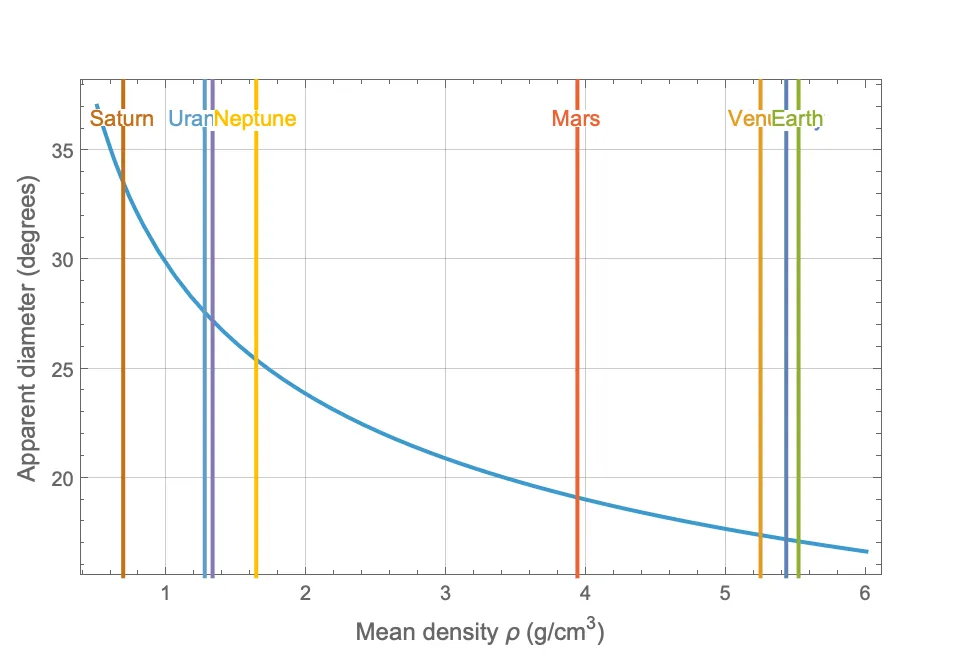
Giant planets are much less dense than terrestrial planets and would therefore appear much larger. But the angular diameter is pretty big in all cases as can be seen from the following figure. This shows a way to visualize the space subtended by various angles by extending your arm between the sky and your eyes:
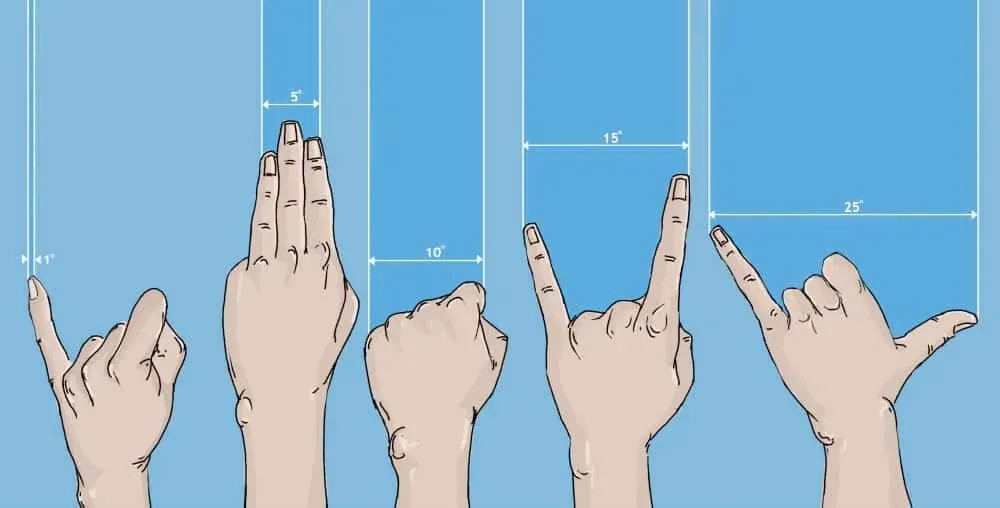
Earth’s moon looks big, but it only takes up 0.5 degrees in our sky. A planet with Neptune’s density would look 50 times bigger from Theia’s surface. This is a great premise for a fictional world if we can make it habitable. We’ll investigate if it can be done in a future post.
Like or comment on bluesky
