The SIR model of infectious diseases
We are currently living through the coronavirus crisis (covid-19). A lot of people have tried to share a little insight on the mechanisms at play in the control of the epidemic and their mathematical modelling. Here, I would like to share a few things I have learnt recently on the subject. I want to insist that I am not an expert in epidemiology and so I do not recommend to use anything that follows as a basis of any decision. I merely want to outline the very broad principles involved in the mathematical modelling of epidemics.
I will focus specifically on the simple SIS and SIR models. This is based on the resolution of non-linear differential equations giving the proportion of people in a population that have been infected by the disease,
In a previous post about exponential growth, we have seen how differential equations like those above define a relationship between functions and their rates of change. The situation here follows the same logic, except that there are now two functions rather than one. The first term of the right-hand side of each equation expresses the fact that the fraction of new infected patients is proportional to the number of persons already infected and to the number of persons that are not and so are susceptible to be. The last term of each equation takes into account the fraction of the infected people that become healthy again. The values of the two real parameters,
It is convenient to set the constant
This is a particular example of the logistic differential equation. If we ignore the second term on the right-hand side for a moment and compare what remains with our well-known equation for the exponential growth, we can identify the combination
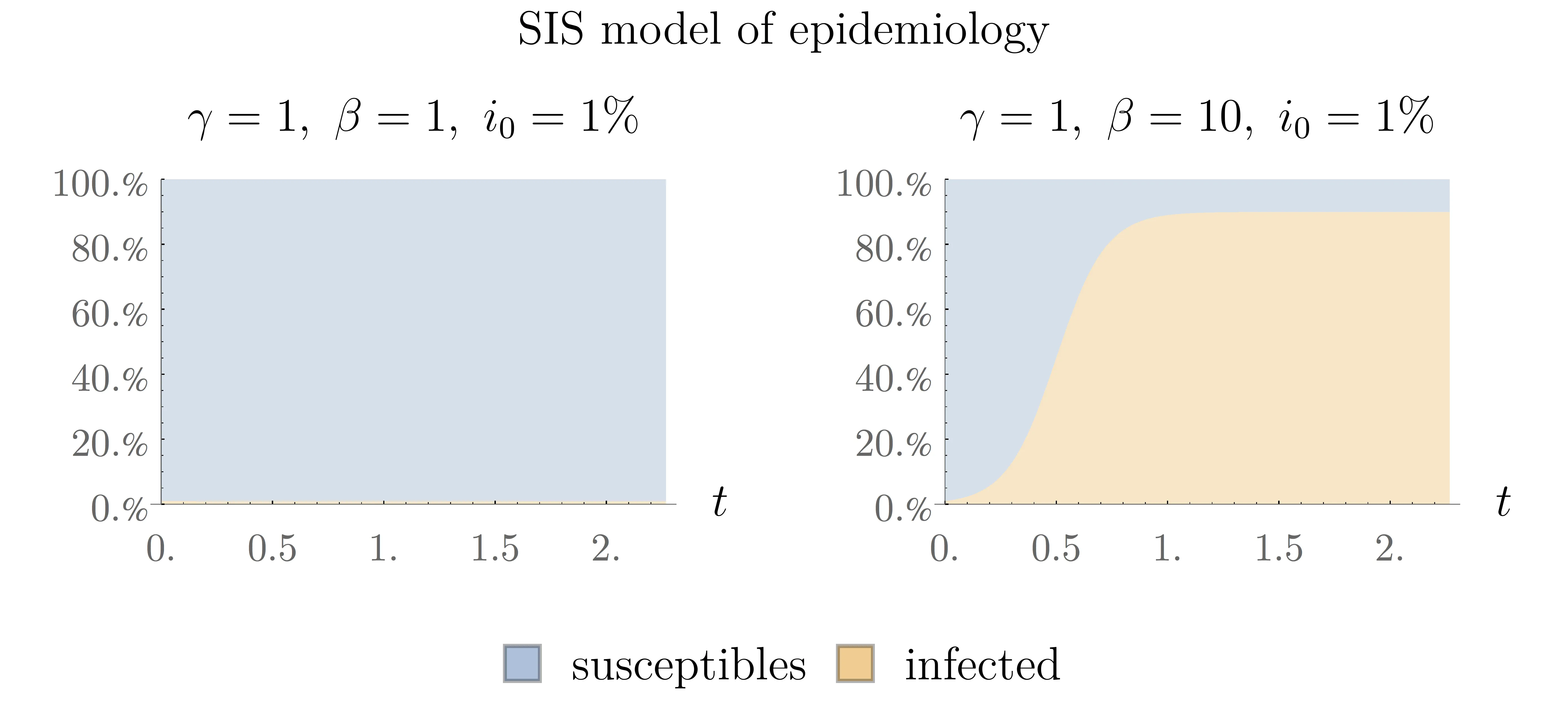
The area in orange represents the fraction of infected people in the population over time and the area in blue represent the fraction of the population that are not infected and are susceptible to be. In both cases, the fraction of infected people starts at
where we have defined
Having considered the simple SIS model in some details, we are now ready to tackle the more sophisticated SIR model. This differs to what precedes in the fact that now we have to look at three equations governing the dynamics of the population between three compartments:
The major difference with Eqs.
where we have inserted the definition of
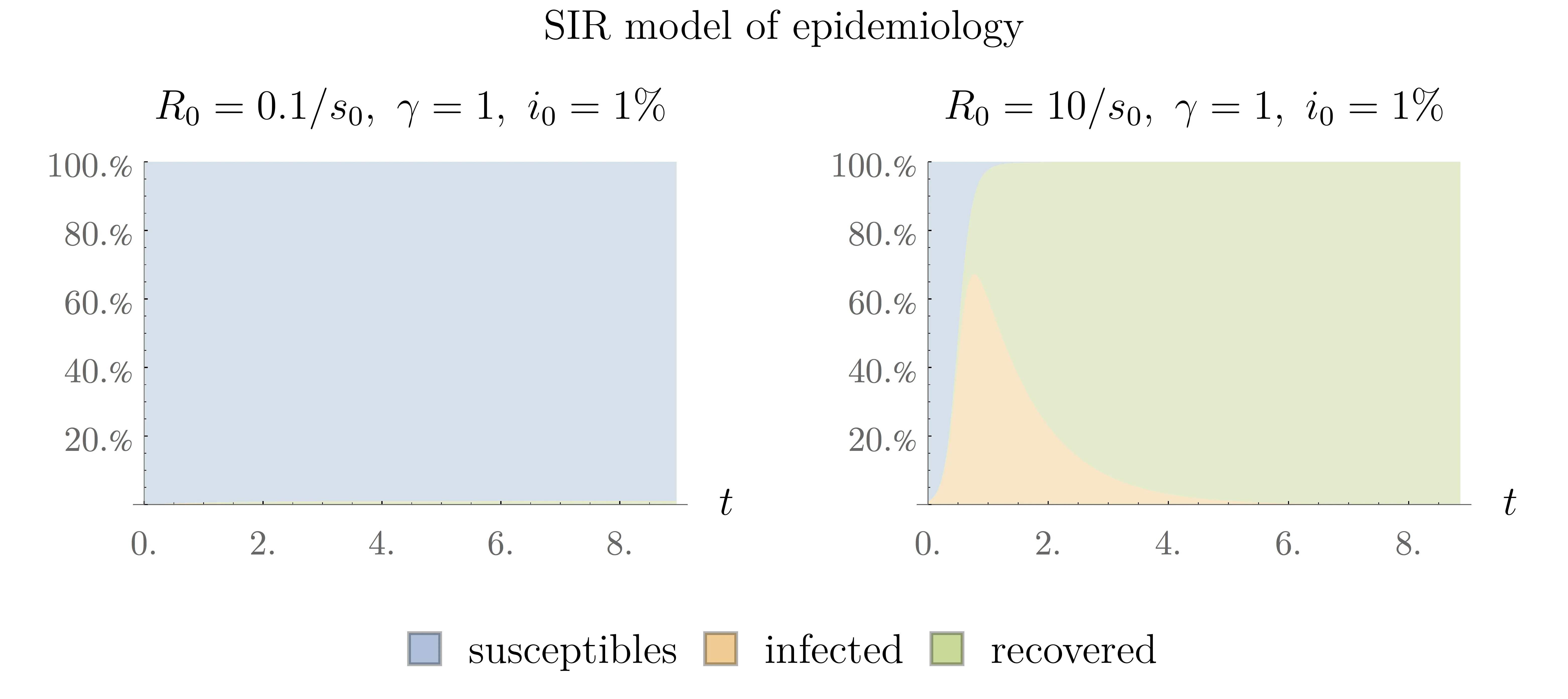
On the left, we can see the situation when
At the moment of writing this note, we are in the middle of a global epidemic of covid-19. A recent estimate heard on the radio mentions that half of the worldwide population lives currently isolated. We are obviously faced with a very infectious disease. We can sometimes see on the news that the isolation measures aim to flatten the curve. This statement can be understood by considering the effect that isolation has on the value of

We can see that the peak of the epidemic gets lower and lower as
Now, it is very important to bear in mind that there are a great deal of aspects that the very simple model above does not take into account. Crucially, by considering the total population as a constant we have always implicitly assumed that you cannot die from the disease regardless of the maximum number of people infected at once. This is obviously not true for an epidemic such as covid-19 which has proved to be very dangerous in many cases so that the survival rate of the population really depends on the capacities of the healthcare system which are obviously finite. Another thing that we did not consider is the possibility that after a short period of immunity following recovery, people become susceptible to become ill again. Such complex dynamics can be accommodated with more sophisticated models of epidemiology.
To conclude this note, I strongly encourage you to have a look at this video if you haven’t already. It deals in the SIR model in considerably more details than I did here. Regarding the covid-19 epidemic specifically, I recommend this note as well as this paper which raises many issues regarding the relevance and the ethical implications of some of the measures that could be implemented to control the epidemic in the long run.